Veteran-Owned Cybersecurity Consultancy

Securing operations without disrupting them.

ICS, SCADA, and OT security assessments, penetration testing, open-source tooling, and SANS training for organizations that operate critical infrastructure.

Where To Start

How Can We Help?

Whether you're a student, a practitioner, or an organization looking for assessment services -- here's how to find what you need.

Learn

Training, mentoring, and course resources for students and practitioners entering ICS/OT cybersecurity.

Use Our Tools

Free, open-source projects for ICS/OT security assessments, hardening, and research.

Work With Us

Security assessments, penetration testing, and research for industrial environments.

Our Expertise

Security Skills

Four disciplines that define our approach to securing industrial environments.

Aggressors

We look at your technology the way adversaries do, searching for the unintended uses, the overlooked paths, and the creative misuse of what was built for another purpose. We do not design industrial processes, but we know how to find the paths through them that others would exploit. Authorized penetration testing and bench testing, conducted with the discipline an ICS/OT environment requires.

Defenders

We help teams prevent, detect, respond, and recover cost-effectively, in ways that fit how your operations actually run. Our offensive work feeds directly into stronger defenses. We focus on implementation issues rather than vulnerabilities, because the devices and solutions in your environment were chosen for a reason. And we threat hunt, looking for what adversaries may already be doing, to shrink the gap between detection, response, and protecting operations.

Researchers

We pull apart devices, protocols, and technologies to understand how they actually work. What we learn goes back to clients, vendors, and the broader community so people can see what they know about their environments, and what they do not. The goal is better decisions across every phase of operations. Many vendors, and too many integrators, miss the minute technical details that have the biggest impact on operational risk. We help teams find and address those details.

Instructors

Knowledge spreads beyond the classroom. Teaching ICS/OT cybersecurity concepts around the world makes industries stronger, makes threat actors' work harder, and prepares the next wave of practitioners to carry the torch. We contribute through SANS courses, workshops, open source projects, conference presentations, and volunteering with non-profit organizations.

Recent

AI Gives Attackers OT Expertise on Demand. Here's What the Technique Looks Like on a Real PLC. (Part 1)

·10 mins
Earlier this week I said AI was closing the knowledge gap for attackers faster than the industry was ready for. This is the technique, demonstrated. TL;DR for OT leadership: Threat actors no longer need years of industrial experience to plan targeted attacks on your operational process. They need your configuration files (logic exports, address maps, HMI project files, manufacturer reference documents) and access to a production AI tool. With those, the AI tool supplies the process expertise the attacker does not have. It reads the logic, infers the physics, maps cross-system dependencies, and produces ranked attack paths with protocol-level instructions for executing them. The industrial-process knowledge gap that used to be a natural barrier against precision attacks has collapsed. For leadership, that changes three priorities. First, configuration files are process intelligence and must be protected like safety documentation. That means backup validation, integrity checks, and inventories of every copy wherever it lives, including copies held by vendors and contractors, and copies on the IT network. Second, remote access to engineering workstations deserves the same scrutiny you apply to your highest-value production systems, because that is where the intelligence lives. Third, the investment required for an adversary to weaponize this technique is trivial. A single analyst workday and a few dollars of API cost. Assume it is in use today, and fund your teams accordingly.

AI Gave Attackers Something We Weren't Ready For. Here's What OT Defenders Need To Do About It.

·7 mins
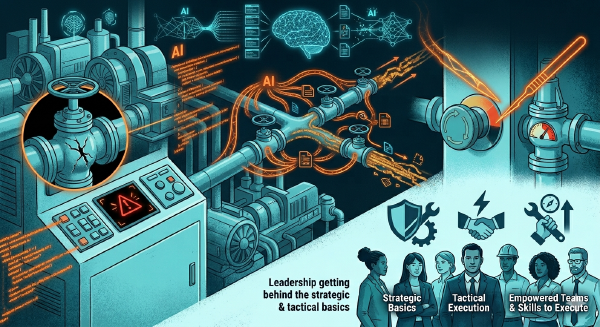
It’s not that attackers got smarter. It’s that the tools available to them are closing the knowledge gap at a pace nobody anticipated. That changes things. TL;DR: AI is accelerating ICS/OT threats in three big ways. Deployed OT solutions will always have some type of vulnerability, it is the nature of this industry. Tools like Mythos can chain vulnerabilities while also manipulating physical process data and the automation pipelines built on top of it. And attackers who previously lacked the domain knowledge to cause precision damage can now get it on demand. Not just shut systems off, but surgically target operational systems. The answer isn’t a new cybersecurity framework. It’s leadership getting behind the strategic and tactical basics, empowering their teams, and making sure those teams have the skills to execute.

Proxmox AI Development Lab

·5 mins
TL;DR # Setting up a proper Windows testing environment for ICS/OT security tool development goes beyond spinning up a single VM. You need multiple Windows versions, from legacy Windows 7 through Server 2022, templated, sysprepped, and network-isolated so you can rapidly deploy clean test systems and tear them down when you’re done. This post summarizes my experience building a Proxmox-based development lab with automated VM management for testing Sysmon configurations and security scripts across every supported Windows version. The complete setup guide is available as a PDF download. We document these projects to both remember what we have done and also help others with similar projects.

Building a Local AI Development Server with Framework Desktop

·4 mins
TL;DR # Using AI/LLM goes beyond using ChatGPT, Gemini, and Claude. Running large language models (LLMs) locally eliminates cloud dependencies, keeps sensitive data on-premises, and provides the computational muscle needed for AI-assisted security research. This post summarizes my experience building a dedicated AI development server using the Framework Desktop with AMD’s Ryzen AI Max+ 395 processor — a system capable of running 70B parameter models entirely in local memory.

Starting Cybersecurity Program for Small ICS / OT Teams

·7 mins
This morning I was thinking about completing an article I was writing about KPIs and OKRs. The more I wrote, the more I realized I was just regurgitating research and making pity comments. Which means, it was crap. So, I refocused and turned to AI to help me. I ask Google’s Gemini the following question.